Is Acetaminophen an Anti-Inflammatory? Complete Guide
Is Acetaminophen an Anti-Inflammatory? What You Need to Know
If you’ve ever reached for acetaminophen when you’re dealing with pain and wondered whether it also treats the inflammation causing that pain, you’re certainly not alone. The terms pain reliever, fever reducer, and anti-inflammatory are often used together, which can make it difficult to understand what a particular medicine actually does.
So, is acetaminophen an anti-inflammatory?
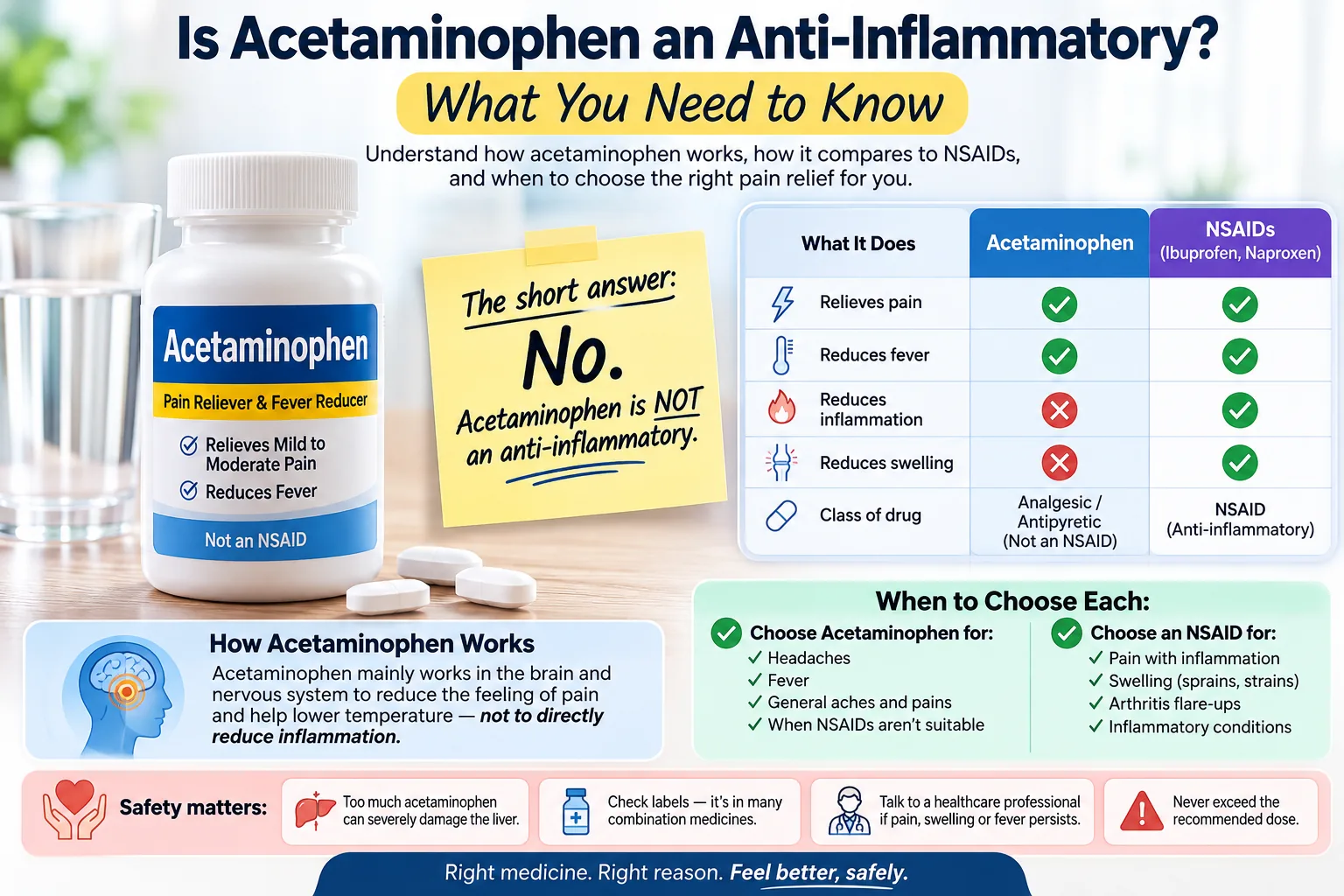
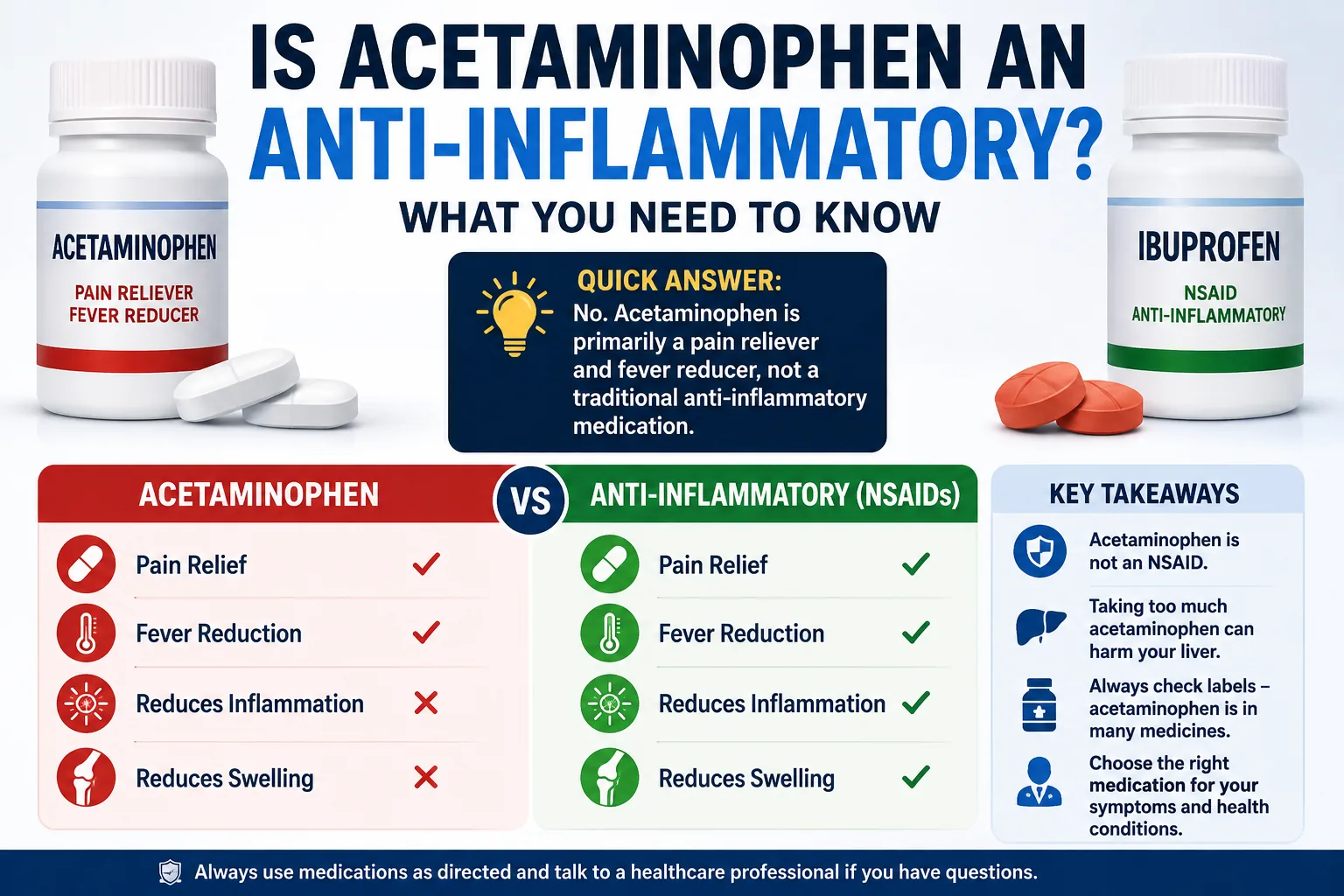
No. Acetaminophen is primarily a pain reliever (analgesic) and fever reducer (antipyretic), not a traditional anti-inflammatory medication. It is also not an NSAID (nonsteroidal anti-inflammatory drug). Medications such as ibuprofen and naproxen are NSAIDs and are specifically used for their ability to reduce pain, fever, and inflammation. MedlinePlus specifically describes acetaminophen as a non-NSAID pain reliever that does not relieve inflammation.
That distinction is important, but it doesn’t mean acetaminophen is ineffective. If you’re experiencing a headache, fever, muscle ache, or another type of pain, acetaminophen may provide meaningful relief. The key is understanding what symptom you’re trying to treat.
If your main problem is swelling and inflammation, however, acetaminophen generally isn’t the medicine you would think of as an anti-inflammatory.
1. What Is Acetaminophen?
Acetaminophen is a widely used medicine for relieving mild to moderate pain and reducing fever. In the United States and some other countries, it is commonly known as acetaminophen. In many parts of the world, the same medicine is called paracetamol.
It is available in numerous forms, including tablets, capsules, liquid medicines, chewable tablets, extended-release products, and combination medications. It can be purchased without a prescription in many settings, while healthcare professionals may also prescribe acetaminophen-containing medicines.
According to MedlinePlus, acetaminophen belongs to the medication classes known as analgesics and antipyretics—meaning pain relievers and fever reducers.
People commonly use acetaminophen for temporary relief of:
- Headaches
- Toothaches
- Muscle aches
- Back pain
- Menstrual pain
- Minor aches and pains associated with colds or flu
- Fever
- Some types of arthritis-related pain
The important point is that pain relief doesn’t necessarily mean inflammation reduction.
That distinction can feel confusing, especially when inflammation is causing your pain. But the body can experience pain through several different mechanisms, and not every painful condition requires an anti-inflammatory medication.
2. What Does “Anti-Inflammatory” Actually Mean?
To understand why acetaminophen isn’t generally classified as an anti-inflammatory, it helps to understand what inflammation means.
Inflammation is part of the body’s response to injury, infection, irritation, or certain diseases. It involves a complicated network of cells, chemical messengers, blood vessels, and immune responses.
Depending on the cause, inflammation may produce symptoms such as:
- Swelling
- Redness
- Warmth
- Tenderness
- Pain
- Stiffness
- Reduced movement
For example, if you sprain an ankle, the affected tissues may become swollen, warm, and painful. The pain is one symptom, while inflammation is part of the underlying biological response.
This is where the difference between acetaminophen and NSAIDs becomes especially relevant.
Acetaminophen can help with the pain associated with a condition, but it does not generally suppress inflammation and swelling in the same way that an NSAID does. MedlinePlus explains that NSAIDs can reduce swelling associated with conditions such as arthritis and muscle strains, whereas acetaminophen does not relieve inflammation.
In other words:
Pain relief and inflammation reduction are related, but they are not the same thing.
3. How Does Acetaminophen Work?
The exact mechanism of acetaminophen is more complicated than a simple “blocks inflammation” explanation.
Acetaminophen primarily acts within the central nervous system, influencing pathways involved in how the body perceives pain and regulates temperature.
This helps explain why it can be effective for:
- Headaches
- Fever
- General aches
- Certain types of muscle pain
- Other mild-to-moderate painful conditions
Its effects are different from those of traditional NSAIDs.
NSAIDs work by inhibiting cyclooxygenase (COX) enzymes and reducing the production of prostaglandins involved in pain, fever, and inflammation. This mechanism contributes to their anti-inflammatory activity.
Acetaminophen has a different pharmacological profile and does not produce the same meaningful peripheral anti-inflammatory effect at usual therapeutic doses.
That is why medical references classify acetaminophen primarily as a pain reliever and fever reducer rather than an anti-inflammatory drug.
4. Does Acetaminophen Reduce Inflammation?
Generally, no—not to a clinically significant degree.
This is perhaps the most important takeaway for anyone searching for “acetaminophen inflammation.”
Acetaminophen can reduce the pain you feel, even when inflammation is part of the condition. But reducing the sensation of pain is different from directly reducing the inflammatory process.
Imagine you have a sore joint that is painful and inflamed.
Taking acetaminophen may make the joint hurt less.
However, that does not mean the medication is substantially reducing the swelling or inflammatory activity in that joint.
This distinction is particularly important when people compare acetaminophen with NSAIDs. NSAIDs are specifically classified as anti-inflammatory drugs because reducing inflammation is one of their therapeutic effects.
So, if your question is:
“Will acetaminophen make my pain feel better?”
It may.
If your question is:
“Will acetaminophen directly reduce inflammation and swelling?”
Generally, no.
5. Does Acetaminophen Reduce Swelling?
Another common question is whether acetaminophen can help with swelling.
Acetaminophen is not generally used to reduce swelling.
If inflammation is causing swelling after an injury, acetaminophen may help reduce the associated pain, but it doesn’t have the same swelling-reducing effect as an NSAID.
For instance, after a minor sprain, someone might experience:
- Pain
- Swelling
- Tenderness
- Stiffness
- Difficulty moving the affected area
Acetaminophen may help with the pain component.
But treating pain doesn’t necessarily mean treating the swelling itself.
This is an important distinction because it can be tempting to assume that feeling better means the underlying problem has improved. Sometimes it does; sometimes the medicine has simply made the symptoms easier to tolerate.
If swelling is severe, rapidly worsening, associated with significant bruising or deformity, or accompanied by numbness or an inability to use the affected body part, medical evaluation may be appropriate.
6. Is Acetaminophen an NSAID?
No. Acetaminophen is not an NSAID.
NSAID stands for nonsteroidal anti-inflammatory drug.
Common NSAIDs include:
- Ibuprofen
- Naproxen
- Aspirin
- Diclofenac
NSAIDs are generally used because they can provide pain relief and anti-inflammatory effects, in addition to reducing fever.
Acetaminophen is different. It is primarily classified as an analgesic and antipyretic.
This distinction matters because the safety considerations are also different.
Acetaminophen’s most important major safety concern is liver toxicity when too much is taken. NSAIDs, on the other hand, have their own risks, including gastrointestinal, kidney, cardiovascular, and other adverse effects depending on the individual medicine and patient.
Neither category is automatically “safe for everyone.”
7. Acetaminophen vs. Ibuprofen: What’s the Difference?
The question “acetaminophen vs ibuprofen” is one of the most common searches surrounding this topic.
Both medications can help relieve pain and reduce fever, but they are not identical.
| Feature | Acetaminophen | Ibuprofen |
|---|---|---|
| Pain relief | Yes | Yes |
| Fever reduction | Yes | Yes |
| Anti-inflammatory activity | Not clinically significant | Yes |
| NSAID | No | Yes |
| Reduces swelling | Generally no | Yes |
| Major safety concern | Liver injury from excessive use | GI, kidney, cardiovascular and other NSAID-related risks |
| Common use | Pain and fever | Pain, fever, and inflammatory pain |
MedlinePlus notes that NSAIDs such as ibuprofen and naproxen can be particularly useful when pain occurs alongside inflammation or swelling.
But this does not mean ibuprofen is automatically the better choice for every person.
Your medical history matters.
For someone with certain gastrointestinal, kidney, cardiovascular, bleeding, medication-interaction, or other risk factors, an NSAID may not be appropriate.
Likewise, acetaminophen may not be appropriate for everyone, particularly when there are concerns involving liver health or excessive cumulative dosing.
The “best” pain reliever is therefore not simply the one with the strongest perceived effect. It is the one that is appropriate for the person’s condition and risk profile.
8. Acetaminophen vs. Naproxen
Naproxen is another NSAID that is frequently compared with acetaminophen.
Like ibuprofen, naproxen has analgesic, fever-reducing, and anti-inflammatory properties.
Acetaminophen primarily targets pain and fever.
Naproxen may therefore be more useful when inflammation is a significant component of a condition, although its NSAID-related risks must be considered.
This is especially relevant when someone has chronic or recurring pain.
For example, a person with joint pain may ask:
“Should I take acetaminophen or an anti-inflammatory?”
There isn’t one universal answer.
The appropriate choice may depend on:
- The source of the pain
- Whether inflammation is present
- Age
- Other medical conditions
- Kidney function
- Liver health
- History of ulcers or gastrointestinal bleeding
- Cardiovascular risk
- Other medications
- Duration of treatment
When you’re uncertain, a pharmacist can often provide practical medication guidance without requiring a lengthy appointment.
9. Can Acetaminophen Help With Arthritis Pain?
Yes, acetaminophen can provide pain relief for some people with arthritis, but it does not treat arthritis-related inflammation in the same manner as an NSAID.
This distinction is especially important because “arthritis” is a broad term covering different conditions.
For osteoarthritis, the American College of Rheumatology/Arthritis Foundation guideline conditionally recommends acetaminophen in certain circumstances, but notes that studies have generally found small effects, and that many people may not experience important benefit from acetaminophen alone. The guideline also notes that acetaminophen may be an option for short-term or episodic use when NSAIDs cannot be used because of intolerance or contraindications.
This is a useful reminder that even when a medicine is commonly used for a condition, it doesn’t necessarily work equally well for everyone.
If arthritis pain is persistent or interfering with sleep, work, walking, exercise, or everyday activities, it may be worth discussing a broader treatment plan with a healthcare professional rather than relying indefinitely on over-the-counter pain medicine.
10. Can Acetaminophen Help With Inflammatory Conditions?
It depends on what you mean by “help.”
If an inflammatory condition is causing pain, acetaminophen may reduce the sensation of pain.
But acetaminophen generally isn’t considered a medication that directly controls the underlying inflammation.
This difference is particularly important in conditions where inflammation itself needs treatment.
For example, certain inflammatory diseases may require specific therapies designed to control the immune response or inflammatory process. Simply reducing pain doesn’t necessarily control the disease.
That’s why persistent symptoms deserve attention.
If your body is repeatedly telling you something hurts, especially when accompanied by swelling, stiffness, warmth, unexplained fever, or other symptoms, treating the pain alone may not address the reason you’re hurting.
You deserve more than temporary symptom relief when an underlying condition needs evaluation.
11. What About Muscle Pain and Sports Injuries?
Acetaminophen may be useful for pain after minor injuries or physical activity, depending on the situation.
However, sports injuries can involve more than pain.
A strained or sprained area may also develop inflammation, swelling, bruising, or limited movement.
Acetaminophen may reduce discomfort without directly reducing the inflammatory response.
For a minor injury, appropriate self-care may involve rest from aggravating activities and other measures depending on the injury. But significant injuries should not be masked with pain medication while continuing activity that could make the injury worse.
Seek medical assessment when pain is severe, the affected area looks deformed, you cannot bear weight or use the limb normally, there is significant swelling, or symptoms aren’t improving as expected.
Pain medication can be helpful—but it shouldn’t be used as a way to ignore warning signs from your body.
12. Acetaminophen and Fever: Why It Can Be Helpful
One area where acetaminophen is particularly well established is fever reduction.
Acetaminophen is classified as an antipyretic, meaning it can help lower an elevated body temperature. It can also make someone feel more comfortable when fever is accompanied by headache or body aches.
But reducing fever doesn’t necessarily mean treating the cause of the fever.
A fever can occur for many reasons, including infections and other medical conditions.
Think of acetaminophen as helping manage a symptom rather than necessarily eliminating its cause.
If fever is persistent, unusually severe, repeatedly returning, or accompanied by symptoms such as difficulty breathing, severe weakness, confusion, dehydration, or other concerning changes, professional medical advice is important.
13. Why Does Acetaminophen Relieve Pain If It Doesn’t Reduce Inflammation?
This is an excellent question because it gets to the heart of the confusion.
Pain and inflammation are connected, but they aren’t identical.
Your nervous system receives and processes signals that contribute to the experience of pain. Inflammation can increase those signals, but pain can also arise through other mechanisms.
Acetaminophen affects pain processing, particularly within the central nervous system.
Therefore, someone can have an inflammatory condition and still experience pain relief from acetaminophen—even though the medicine isn’t significantly suppressing the inflammation itself.
A simple way to remember it is:
Acetaminophen can turn down the pain signal without being an inflammation-targeting medicine.
This is one reason why the terms “pain reliever” and “anti-inflammatory” shouldn’t be treated as interchangeable.
14. Is Acetaminophen Safer Than Anti-Inflammatory Drugs?
This question deserves a nuanced answer.
There is no medication that is completely risk-free, and acetaminophen and NSAIDs have different safety profiles.
Acetaminophen’s most important concern is the liver.
Taking too much acetaminophen can cause severe liver damage, liver failure, and potentially death. The FDA states that adults and children 12 years and older should not exceed 4,000 mg of acetaminophen in 24 hours from all sources, while individual product labels and personal medical circumstances may call for different limits.
One of the most common problems is accidental duplication.
For example, someone may take a pain reliever containing acetaminophen and then take a cold or flu product that also contains acetaminophen.
They may not realize they are adding the doses together.
That’s why checking the active ingredients on every medication label is so important.
15. Acetaminophen and Liver Safety
Acetaminophen can be safe when used appropriately, but excessive amounts can be dangerous.
The FDA warns that taking too much acetaminophen can result in liver failure and death.
MedlinePlus similarly warns that taking more than recommended or accidentally combining multiple acetaminophen-containing medicines can cause serious liver injury.
Be particularly careful if:
- You take multiple prescription or OTC medicines
- You regularly use combination cold or flu products
- You have liver disease
- You consume substantial amounts of alcohol
- You aren’t sure whether another medication contains acetaminophen
Acetaminophen may appear on labels under names or abbreviations such as APAP, so checking carefully can prevent accidental duplication.
If you believe you have taken too much acetaminophen, don’t wait for symptoms to appear. The FDA recommends seeking medical help promptly after an overdose.
16. Can You Take Acetaminophen and Ibuprofen Together?
Sometimes healthcare professionals recommend using acetaminophen and an NSAID together because they work differently.
However, that doesn’t mean everyone should combine them on their own.
Before taking multiple pain relievers, consider:
- The active ingredients
- The dose of each medication
- How frequently each medication is being taken
- Your medical conditions
- Other prescription medicines
- Other OTC medicines
- How long you expect to use them
If you are unsure whether two medicines can be combined, a pharmacist is an excellent person to ask.
Most importantly, don’t assume that combining medications automatically provides better or faster relief. More medication also means more opportunities for side effects, dosing mistakes, and interactions.
17. Acetaminophen and Combination Medicines
Another reason people accidentally exceed recommended acetaminophen amounts is that the drug appears in many combination products.
Acetaminophen can be found in some medicines used for:
- Colds
- Flu symptoms
- Headaches
- Cough
- Allergy symptoms
- Sleep
- Prescription pain relief
MedlinePlus notes that acetaminophen is present in many OTC and prescription medicines.
This means that simply counting “pills” isn’t enough.
Two different products may contain the same active ingredient.
Before taking a new medicine, look at the Active Ingredients section of the label. If you’re unsure, ask a pharmacist to review your medications.
18. What Should You Choose for Pain With Inflammation?
This is where the answer becomes personal.
If pain is accompanied by significant inflammation or swelling, an NSAID may offer an advantage because it has anti-inflammatory properties.
If the primary concern is pain or fever and an NSAID isn’t appropriate, acetaminophen may be considered in some circumstances.
But there isn’t a universal “best painkiller.”
A healthcare professional may take into account:
- The cause of the pain
- How severe it is
- Whether swelling is present
- Your age
- Your kidney function
- Your liver health
- Your gastrointestinal history
- Cardiovascular risks
- Other medicines
- Pregnancy or other special circumstances
The safest choice is the one that fits your particular situation, rather than simply following a general internet recommendation.
19. When Should You Stop Treating Pain Yourself?
Occasional headaches or minor aches may be reasonable to manage with an appropriate OTC medicine.
Persistent or unexplained pain is different.
Talk with a healthcare professional if:
- Pain keeps returning
- Pain is becoming more severe
- You need pain medicine frequently
- Swelling persists
- A joint becomes increasingly stiff or difficult to move
- You have unexplained fever
- An injury isn’t improving
- Pain interferes with sleep or everyday activities
- You aren’t sure which medication is appropriate
Your symptoms are worth understanding.
Pain relief can be helpful, but repeatedly covering up a symptom without investigating its cause may delay appropriate treatment.
20. What Happens If You Take Too Much Acetaminophen?
Taking too much acetaminophen can cause serious liver injury, and a person may initially feel relatively well even after taking a dangerous amount.
That is why suspected overdose should be treated as urgent rather than waiting for symptoms.
The FDA specifically advises people who believe they have taken too much acetaminophen to get medical help or contact Poison Help immediately.
Potential warning signs of serious liver injury can include:
- Nausea or vomiting
- Upper abdominal pain
- Yellowing of the skin or eyes
- Dark urine
- Pale stools
- Unusual weakness
However, do not wait for these symptoms before seeking help after a suspected overdose.
If you’re in the United States and believe you’ve taken too much, Poison Help can be reached at 1-800-222-1222, as listed by the FDA.
21. What Does the Research Say About Acetaminophen for Arthritis?
The evidence is particularly useful for understanding why “pain relief” and “anti-inflammatory treatment” should not be confused.
The American College of Rheumatology/Arthritis Foundation’s osteoarthritis guideline conditionally recommends acetaminophen for hand, hip, and knee osteoarthritis, but emphasizes that clinical trial effect sizes are small and that acetaminophen may provide little meaningful benefit for many people.
The same guideline strongly recommends certain non-drug interventions and NSAID approaches in appropriate patients, highlighting that osteoarthritis treatment shouldn’t be reduced to simply choosing a painkiller.
This is an important message for anyone living with chronic pain:
The goal isn’t simply to take something that makes the pain disappear temporarily. The goal is to find a safe, sustainable approach that helps you function and addresses the underlying condition when possible.
22. Common Myths About Acetaminophen and Inflammation
Myth 1: “If it relieves pain, it must reduce inflammation.”
Not necessarily.
Acetaminophen can relieve pain without being a significant anti-inflammatory drug.
Myth 2: “Acetaminophen is an NSAID.”
False.
Acetaminophen is not an NSAID.
Myth 3: “Acetaminophen reduces swelling.”
Generally false.
It can relieve pain associated with a swollen or inflamed area but doesn’t have the same swelling-reducing effect as NSAIDs.
Myth 4: “Acetaminophen is always safer than ibuprofen.”
Not necessarily.
The medicines have different risks. Excessive acetaminophen can seriously damage the liver, while NSAIDs have their own important risks.
Myth 5: “If one acetaminophen product doesn’t work, I can take another.”
Be careful.
The second product may contain acetaminophen too. Always check active ingredients before combining medicines.
23. Frequently Asked Questions About Acetaminophen and Inflammation
Is acetaminophen an anti-inflammatory?
No. Acetaminophen is primarily a pain reliever and fever reducer. It is not considered a traditional anti-inflammatory medication.
Does acetaminophen reduce inflammation?
Not significantly. It may reduce pain associated with inflammation, but it generally does not suppress inflammation in the way NSAIDs do.
Does acetaminophen reduce swelling?
Generally, no. Acetaminophen can help with pain but isn’t considered a swelling-reducing medication.
Is acetaminophen an NSAID?
No. Acetaminophen is not a nonsteroidal anti-inflammatory drug.
Is ibuprofen an anti-inflammatory?
Yes. Ibuprofen is an NSAID and has anti-inflammatory properties.
Is naproxen an anti-inflammatory?
Yes. Naproxen is also an NSAID with anti-inflammatory effects.
Is acetaminophen good for arthritis?
It can provide pain relief for some people with osteoarthritis, but its average benefit may be modest. It doesn’t treat arthritis-related inflammation in the same manner as NSAIDs.
Can acetaminophen help a swollen knee?
It may reduce pain from a swollen knee, but it generally won’t directly reduce the swelling. Persistent or significant knee swelling should be evaluated to determine its cause.
Can acetaminophen help with muscle inflammation?
It can reduce muscle pain, but it isn’t considered a medication that significantly reduces muscle inflammation.
Can I take acetaminophen with an NSAID?
Sometimes they are used together, but this should be done with attention to dosing, other medicines, medical conditions, and individual risks. Ask a healthcare professional or pharmacist if you’re unsure.
What is the biggest safety concern with acetaminophen?
Taking too much can cause serious liver injury. The FDA warns against exceeding the maximum total daily amount and emphasizes checking all medicines for acetaminophen.
What is acetaminophen called outside the United States?
It is commonly called paracetamol in many countries.
24. Key Takeaways: Acetaminophen vs. Anti-Inflammatory Medicines
If you remember only a few things from this article, remember these:
1. Acetaminophen is not an NSAID.
It belongs primarily to the analgesic and antipyretic categories.
2. Acetaminophen is mainly used for pain and fever.
It can be helpful for headaches, body aches, and many other types of mild-to-moderate pain.
3. Acetaminophen does not significantly reduce inflammation.
If swelling and inflammation are central to your symptoms, an NSAID may work differently.
4. Pain relief doesn’t necessarily mean inflammation is gone.
A medicine can make you feel better without directly treating the underlying inflammatory process.
5. Acetaminophen has important safety considerations.
Taking too much can cause potentially life-threatening liver injury.
6. Check combination medicines carefully.
You may unknowingly take acetaminophen from multiple products.
7. Don’t assume that one medication is right for everyone.
Your medical history, other medicines, and the cause of your pain all matter.
Final Thoughts: Is Acetaminophen an Anti-Inflammatory?
So, is acetaminophen an anti-inflammatory?
The answer is no.
Acetaminophen is primarily a pain reliever and fever reducer, while medicines such as ibuprofen and naproxen belong to the NSAID family and have meaningful anti-inflammatory effects.
That doesn’t make acetaminophen an inferior medication. It simply means that it serves a different purpose.
If you’re dealing with a headache, fever, or everyday ache, acetaminophen may offer the relief you’re looking for. If you’re dealing with substantial swelling or inflammation, however, you may need to discuss other treatment options with a healthcare professional.
Most importantly, don’t feel pressured to figure everything out by yourself. Medication names, active ingredients, dosing limits, and drug interactions can be confusing—even for people who take medicines regularly.
And if your pain is persistent, severe, unexplained, or interfering with your life, that’s a reason to seek help rather than simply taking another dose.
Your pain is real, your questions are valid, and understanding what a medication can—and cannot—do is an important part of using it safely.
Medical disclaimer: This article is for general educational purposes and is not a substitute for individualized medical advice. Medication choices and doses should be discussed with a healthcare professional when you have medical conditions, take other medicines, or have questions about safe use.